
What Does Your Brand Actually Sound Like? (Most Can't Answer That.)
Your brand has a font. A color palette. A tone of voice. A set of brand guidelines thick enough to brief any agency, anywhere in the world.
But if someone asked you right now. What does your brand actually sound like? What would you say?
Most brands go quiet at that question. Not because they have not thought about it. Because the answer is honest: they do not know. And more uncomfortably, neither does anyone else on the team.
That is not a small gap. That is a strategic one.
Every brand has a visual identity system. Almost none have a sound one.
Think about what exists in a typical brand toolkit. There is a logo with clear usage rules. A color system with precise hex codes. A typographic hierarchy. An image style guide. A tone of voice document. In some cases, a full brand book running to eighty pages.
These exist because visual consistency has been taken seriously as a business discipline for decades. Agencies built frameworks for it. Clients invested in it. Schools taught it.
Sound did not get the same treatment.
95% of companies have brand guidelines, but they cover visual identity. Sound is typically absent. Music is chosen late, by feel, by whoever is editing the content that week. Different teams make different choices. The campaign sounds different from the social content, which sounds different from the product experience. Nothing holds together.
Meanwhile, 97% of senior marketing leaders now agree that a well-defined brand sound strategy significantly contributes to customer loyalty and engagement. Most brands still treat sound as a finishing touch rather than a foundational layer.
And this gap is becoming harder to ignore.
Recent research from Spotify’s 2026 Sound-On Era report shows that audio is no longer a supporting layer in brand communication, but a foundational one. In the study, 70% of advertisers said audio captures focused attention more effectively than cluttered visual or social platforms, 74% of consumers said they remember the audio content they listen to, and 80% of advertisers said audio ads benefit from greater listener trust than other digital media.
In other words: attention, memory, and trust, the things brands are fighting for, are increasingly shaped through sound.
At the same time, brands are producing more sound-bearing content than ever. Reels, TikToks, podcasts, ads. The volume is increasing, but the systems behind it are not.
That is where the gap becomes visible. That disconnect is where the opportunity lives.
Sound is not decoration. It is the thing your audience feels before they think.
There is a reason music in advertising works so reliably. It bypasses the analytical part of the brain and lands directly in the emotional one. Auditory memory is processed in brain regions closely linked to emotion, which is why a piece of music can transport you instantly to a specific moment, a feeling, a version of yourself.
Brands that understand this do not use music to fill silence. They use it to shape perception.
The numbers are hard to ignore. Brands that use music aligned with their brand identity are 96% more likely to be remembered by consumers than brands using unfitting music or no music at all. Sound identities can also achieve recognition 8 times faster than visual logos alone.
“Meaning your audience processes your brand in sound before they have finished reading your logo.”
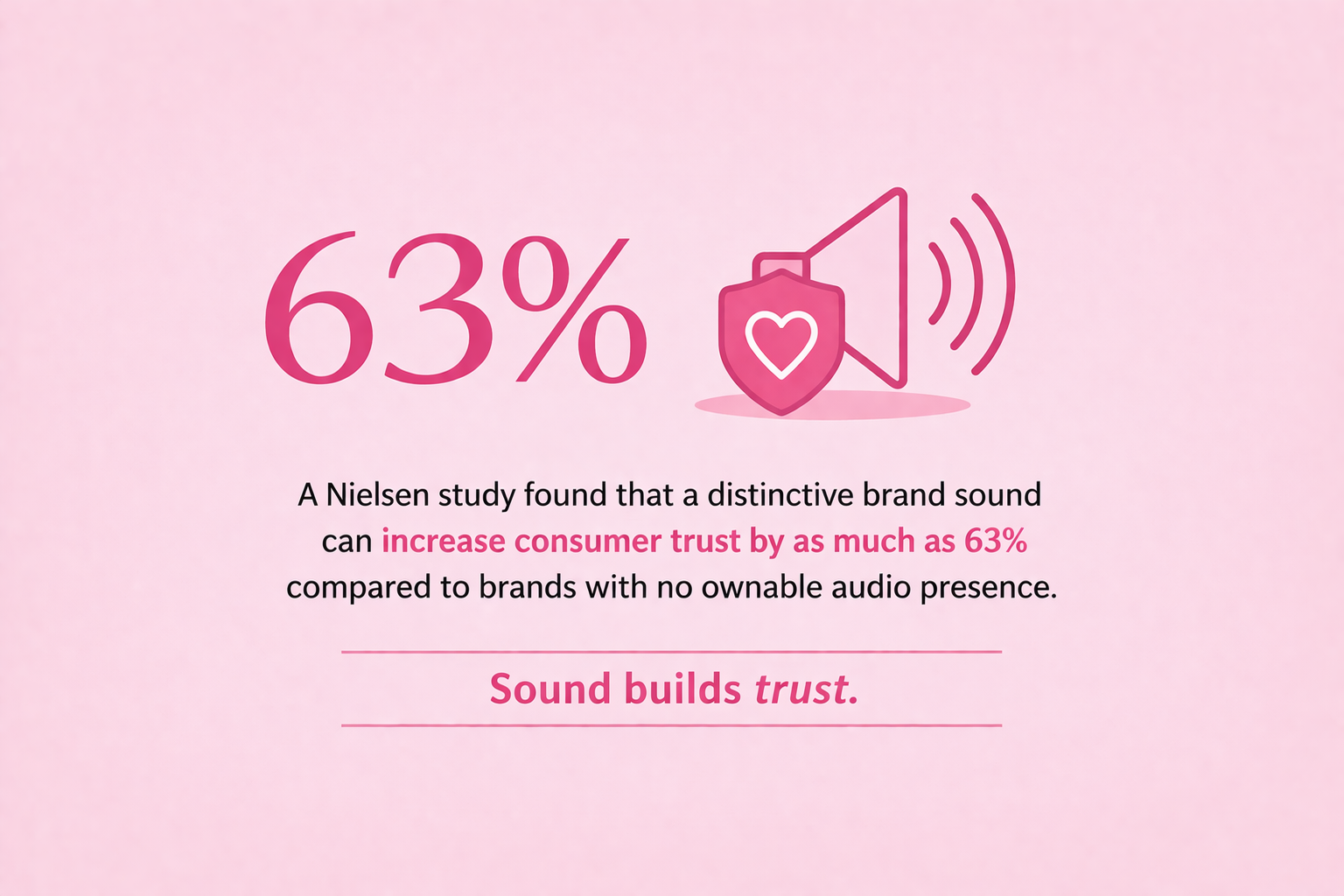
The effects compound at scale. MasterCard reported that within 12 months of launching their brand sound identity, 77% of customers said it made their brand feel more trustworthy. Tostitos saw a 38% increase in brand recall within six months of introducing a consistent sound identity. A Nielsen study found that a distinctive brand sound can increase consumer trust by as much as 63% compared to brands with no ownable audio presence.
The question is not whether sound matters. The research has answered that repeatedly. The question is whether your brand has a sound system, or just a habit.
The difference between a music choice and a Sound Aesthetic
A music choice is what happens when someone opens a streaming platform, picks something that feels right for the mood, and exports the video.
A Sound Aesthetic is something else entirely. It is the emotional and sensory logic that sits behind all of your brand's sound decisions, across campaigns, content, product, events, and every touchpoint where sound is present.
It answers questions like:
How much space does the music leave? Does it breathe, or does it crowd?
Does it feel polished or raw? Human or architectural?
What emotional register does it consistently land in, and does that register match the brand promise?
When a new team member picks music for a campaign brief, what do they reach for? And does that align with what every other team member would reach for?
A Sound Aesthetic is not a playlist. It is not a reference track. It is a set of emotional guardrails specific to your brand, clear enough to brief an external director, a music supervisor, a social content team, or a new agency without starting from zero every time.
Music-evoked emotions significantly influence brand preferences and engagement levels. Consistent and reasoned musical choices are what make that influence work for your brand rather than against it. Music aligned with a brand's identity increases purchase intentions. When the fit is wrong, it creates friction — and consumers notice, even when they cannot articulate why.
Most brands do not have a Sound Aesthetic. That is not a failure of taste. It is a failure of system.
What a Sound Aesthetic system actually does
A Sound Aesthetic system does not start with music. It starts with brand identity, who you are, what you stand for, how you want people to feel when they encounter you.
The translation from identity to sound is exactly where most brands lose the thread. Not because they lack taste. Because they lack a process. Without a structured approach, every creative partner, every campaign team, every content producer makes their own interpretation. The result is inconsistency that compounds across every touchpoint.
A properly built sound system gives teams a working reference, not a mood board that dates quickly, not a single approved track, but a set of emotional and aesthetic guardrails that hold regardless of who is making the decision. Music choices get made faster. Brand fit improves. Rights risk goes down. And the cumulative effect of consistent sound starts to build.
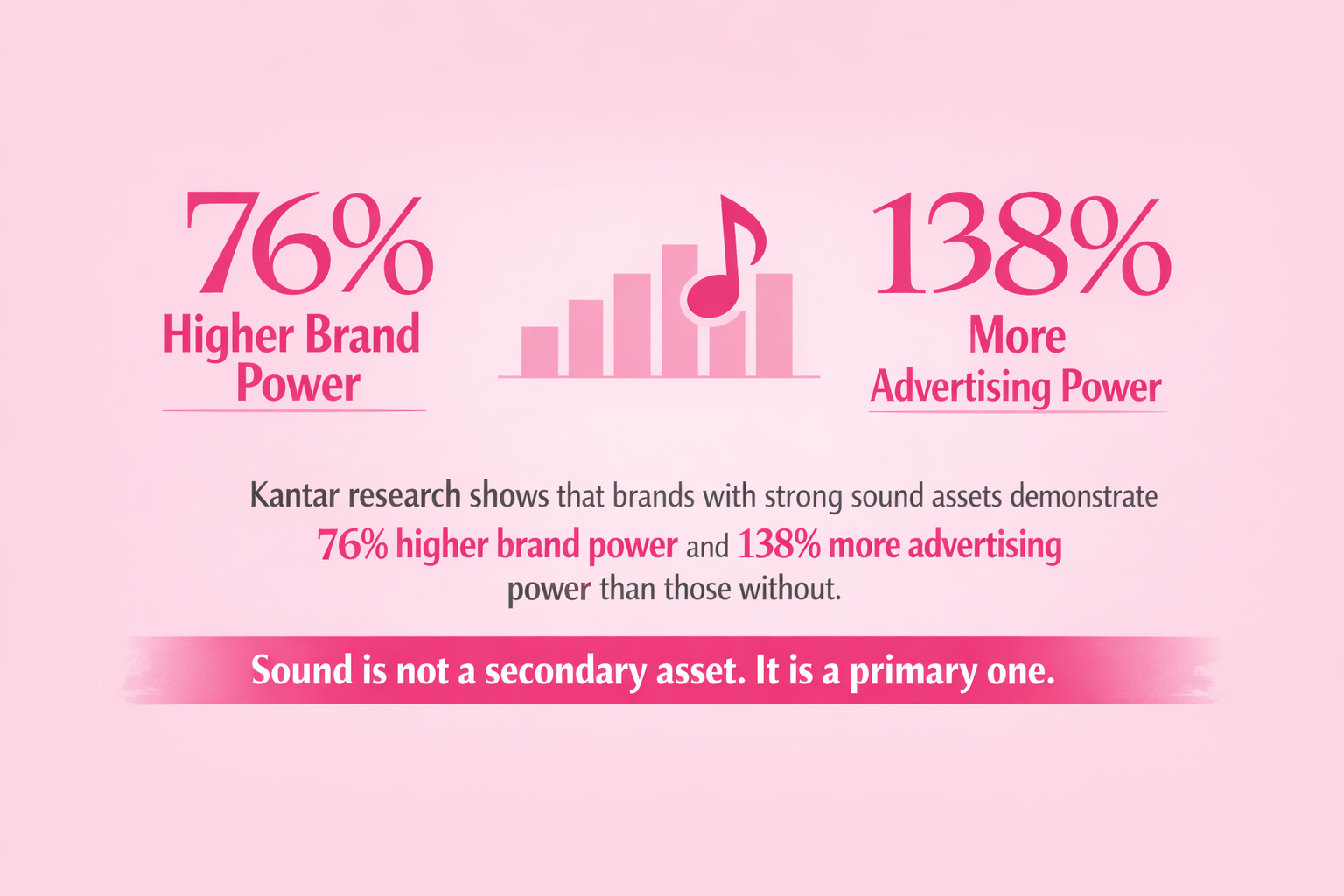
Kantar research shows that brands with strong sound assets demonstrate 76% higher brand power and 138% more advertising power than those without. Sound is not a secondary asset. It is a primary one.
At SHE SOUNDS., this is the work we do. We build the system that makes consistent, brand-fit sound decisions possible at scale, and we do it in a way that is rights-aware from the start, not cleared in a panic at the end.
Why this matters most right now
Social content has changed the equation. Brands are producing more sound-bearing content than ever before, Reels, TikToks, Shorts, Stories, branded podcasts, campaign films, event content, product demos. Every single one carries a sound signal.
Without a Sound Aesthetic, each piece is a separate decision. Each decision is a separate guess. The cumulative effect is noise, not brand.
With a Sound Aesthetic, each piece reinforces the same emotional world. The audience may not consciously notice it. But they feel it. That feeling is trust. And trust is what turns an audience into a customer.
88% of TikTok users say sound is essential to the platform experience, with 73% reporting they would stop and engage with an ad that has audio. The brands that have already built a sound system are ahead. Every piece of content they publish compounds. Every piece your brand publishes without one is a missed opportunity to be recognised.
The practical check
Strip the visuals from the last three pieces of content your brand published. Just listen.
Does it sound like your brand? Does it sound like the same brand across all three? Could someone identify it as yours without seeing the logo?
For most brands, the honest answer is no. That is the gap. And it is still wide open.
If you want to understand where your brand stands in sound and what it would take to build a Sound Aesthetic that actually holds, that is exactly what we do.
Book a complimentary 15-minute Brand Sound Check.
We will tell you where your sound aligns, where it creates friction, and where the opportunity is.
SHE SOUNDS. is a female-led Music Consultancy and Creative Studio based in Sweden. We work with brands, creators, and agencies to build Sound Aesthetics that are emotionally intelligent, rights-aware, and built around your values — not industry defaults.
Sources
Lucidpress & Demand Metric. (2019). State of Brand Consistency Report.lucidpress.com
amp & Spotify. (2024). Best Audio Brands Report 2024: Brand sound strategy and performance survey.ampsoundbranding.com
Spotify. (2026). The Sound-On Era: Consumer, advertiser, and expert research report. https://ads.spotify.com/en-US/news-and-insights/sound-on-era/
LaBar, K.S., & Cabeza, R. (2006). Cognitive neuroscience of emotional memory. Nature Reviews Neuroscience, 7(1), 54-64. https://doi.org/10.1038/nrn1869
Audio Branding Academy, cited via Big Invisible. Brands using aligned music are 96% more likely to be remembered. biginvisible.com
Rebellion Group. (2025). Brand sound: Leveraging the power of sound for your brand. rebelliongroup.com
WithFeeling. (2025). Strategic use of sound in branding. withfeeling.com
Anglada-Tort, M., et al. (2022). I've heard that brand before: The role of music recognition on consumer choice. International Journal of Advertising, 41(4). https://doi.org/10.1080/02650487.2022.2060568
Audiodraft. (n.d.). Audio branding is the key to brand recognition and recall. audiodraft.com
RetailNext & Brandtrack. (n.d.). Music matters: How in-store music shapes shopper behavior. retailnext.net
Musicbed / WARC. (n.d.). Sounds like success: How brand sound can unlock brand potential. warc.com
Nielsen. (2015). I second that emotion: The emotive power of music in advertising.nielsen.com
Hou, J., Zhao, X., & Zheng, J. (2019). The impact of consistency between the emotional feature of advertising music and brand personality on brand experience. Journal of Management Analytics, 6(3), 250-268. https://doi.org/10.1080/23270012.2019.1600842
