
Dumbphones & Vinyl: Why Gen Alpha’s 16th Birthday is an Analog Revolution.
They are YouTube-native, sound-literate, and already shaping what gets trusted. In rooms where music does more work than any caption ever will.
Your visuals can be curated and your audio can still drift. That gap is why some brands look premium but land messy, especially with Gen Alpha. If YouTube is the default screen in the home, sound stops being a background layer and starts acting like the interface.
The oldest Gen Alphas turn 16 in 2026, and that is not a future-tense audience. They are old enough for social media accounts, old enough to shape trends, and increasingly old enough to make independent consumption choices, even when the money technically sits with parents.
Here is the SHE SOUNDS. lens: sound is identity on social. A sound aesthetic is a taste signal, and taste gets remembered when there is structure behind it. That structure includes rights-led music direction and licensing clarity, because Reels-safe does not mean risk-free. Youth culture does not forgive carelessness.
YouTube-First Is Not a Platform Preference.
It Is a Format Logic.
Precise TV's 2025 data puts YouTube at 78% of viewership among US children aged 2–12, more than twice the reach of broadcast television. Ofcom confirms the same pattern in the UK: when Gen Alpha switches on the television, YouTube is the first destination, before any streaming service or broadcast channel. Over 30% of 8–12 year olds watch YouTube Shorts for more than two hours per day.
That is not passive consumption. That is a trained aesthetic. Creator-led storytelling, tighter hooks, faster emotional payoff, and music that has to earn its place inside that pacing, not politely underneath a TV spot.
The friction is simple: brands manage visuals with discipline, then treat music like a last-minute vibe check. The result is inconsistent emotional tone, licensing panic, and a feed that feels like five different personalities. When audio changes every week, brand memory breaks. Gen Alpha clocks it in seconds. When the screen is YouTube-first, your audio choices are your interface. The question is whether those choices are intentional.
The Feed Isn't Where They Live
The assumption that Gen Alpha will broadcast the way Gen Z did is already wrong. The oldest Alphas are moving away from public feeds and into group chats, Discord servers, DM-only circles, and closed gaming ecosystems like Roblox. These are not secondary platforms. They are primary social worlds where culture gets built, references get shared, and brand perception gets formed in ways that traditional reach metrics cannot see.
The shorthand version: a 16-year-old in 2026 is less likely to post an outfit to a public grid and more likely to share it in a circle of five friends who will actually weigh in. That private circle is the audience that moves taste. Public influencer campaigns optimised for impressions are increasingly out of step with how influence actually travels for this generation.
For brand audio, this changes the brief entirely. Sound has to earn the forward. A track that performs in the algorithm is not the same as a track someone shares in a private thread at midnight. The difference is character. Brands measuring success by public feed metrics are consistently missing the rooms where the real cultural work happens.
What the Spending Power Number Actually Means
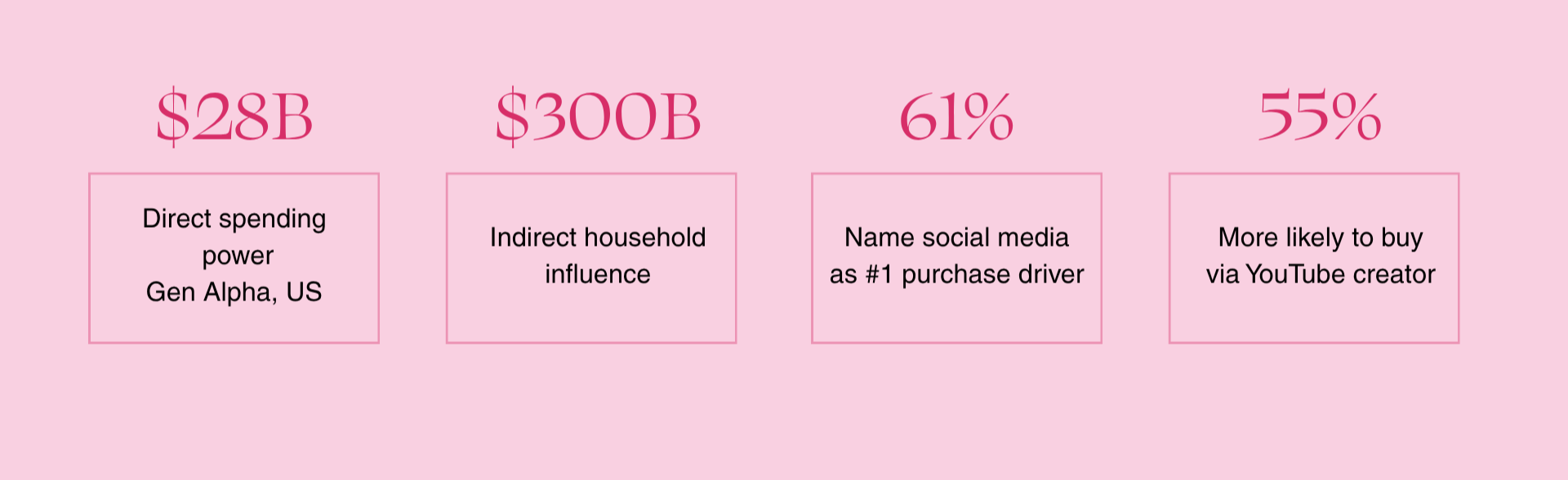
Brandwatch cites Gen Alpha holding $100 billion in spending power, with older Gen Alphas gaining more control over how that money moves. That figure gets repeated a lot, but it tends to flatten the more interesting part of the story. Gen Alpha's direct spending (the money they control themselves) sits closer to $28 billion. Their influence on household decisions adds roughly $300 billion more. The gap between those numbers is not noise. It is the mechanism that makes this generation strategically different from any cohort brands have had to reach before.
Gen Alpha earns trust with parents by being ahead of the curve on what is credible, what is cool, and what is worth paying for. Then the money follows. This means the brands that matter to Gen Alpha are the brands Gen Alpha teaches their parents to trust. 61% of Gen Alpha point to social media as their primary purchase driver, outpacing peer influence and traditional advertising. 55% are more likely to buy something if a YouTube or Instagram creator they trust recommends it, and 49% say they trust creators as much as family and friends. If your sound is inconsistent on social, you are not just losing attention. You are being quietly disqualified from the chain that actually moves money.
Sound as Identity, Including Physical Sound
Here is the detail most brand teams are missing entirely. Key Production's 2025 study of over 2,000 respondents found that 46% of Gen Alpha (ages 1–16) listen to CDs and 38% listen to vinyl. More than half know how to use a CD player, and only 1 in 5 parents prefer their children to listen via smartphone. This is not nostalgia. It is identity work. As Karen Emanuel, CEO of Key Production, put it: "For many of these young listeners, physical music offers something digital formats can't: a sense of authenticity, ownership, and emotional connection." Owning an album functions like owning a piece of fashion or art: a display of taste, a form of participation in culture that goes beyond the act of listening.
The same logic runs through their streaming behavior. Bridge Ratings research found that 33% of Gen Alphas are already subscribed to a music streaming service, with listening habits spanning hip-hop, reggae, R&B, gaming soundtracks, and world music in combinations that resist traditional genre segmentation. Playlists are narratives for this generation. Mood, identity, and cultural literacy get signalled through what they play and what they skip. The point for brands is that Gen Alpha already understands sound as a taste signal. They have been developing that fluency since childhood, across physical and digital formats. If your brand's audio palette cannot pass that test, it will not pass theirs.
“For many of these young listeners, physical music offers something digital formats can’t: a sense of authenticity, ownership, and emotional connection.”
The Screen Isn't Always Where They Want to Be
The vinyl and CD data is one signal. The wider pattern has a name now: digital burnout, hitting an age group younger than anyone expected. The oldest Alphas grew up the most always-on, and they are the first to push back against it. Dumbphones are being requested as birthday gifts. Film photography is a real craft practice again. Print books are up. Physical third spaces (record shops, climbing gyms, ceramics studios) are gaining cultural cachet precisely because they exist outside the feed.
Here is the specific sting for brands. The Alphas choosing to reduce screen time are not the peripheral ones. They are the taste-setters: the most culturally active segment, the ones other Alphas look to for signals. A strategy that is 100% digital risks being invisible to exactly the people most likely to shape what the rest of the cohort decides is worth caring about.
For sound strategy, the question is practical: where does your music exist when the screen is off? In a physical retail space, at an event, on a product? A brand sound that functions only inside a Reel is half a sound strategy. The Alphas opting out of the scroll are not opting out of sound.
Always-On: Sound Has to Work in Fragments and Still Feel Human
Common Sense Media and Hopelab's research flags the reality of heavy, near-constant social use among young people: US children aged 8–12 average around 4 hours 44 minutes of screen time per day. That volume changes the creative brief. Sound must land in fragments while still building toward something recognisable. Micro-recognition in the first one to two seconds matters, and it has to ladder back to a stable sound palette so your brand does not turn into noise inside a day that is already saturated with it.
Equity sits inside this too, and it is worth naming directly. When brands push the same attention mechanics to everyone, some groups get overstimulated, stereotyped, or targeted more aggressively than others. UNICEF Innocenti's Childhood in a Digital World (2025) frames digital life as an ecosystem tied to opportunity, inequality, and wellbeing. OHCHR's findings on children's digital rights add that young people want participation and transparency, not just protection. If your music strategy depends on exploiting attention mechanics, Gen Alpha will feel it as control. If it is consent-aware and rights-led, they feel it as respect. Consistency lives in the feeling, and feeling is where trust starts.
AI Is Their Co-Pilot. Is Your Brand Even Readable to It?
The article treats technology as something Gen Alpha uses. The more accurate framing is that AI is a collaborator. A 16-year-old in 2026 is not just Googling products. They are asking their personal AI agent to find the most ethical option, the best-reviewed version, or the one that matches what they already own. Brand discovery is shifting from search results to AI-generated recommendations. Being found by a human scrolling a feed and being found by an AI agent pulling the best options for a specific request are now two entirely different challenges.
This has a direct implication for brand legibility. If your positioning is vague, your values are buried, your music direction is undocumented, your brand may simply not exist in the results an AI surfaces. Clarity about who you are and what you stand for is no longer just a marketing nicety. It is infrastructure.
The emotional register still matters on top of all of this. An AI agent can surface your brand. Whether a 16-year-old trusts the feel of it when they arrive is still a human question, and sound is doing a significant part of that work. Your Brand Sound Identity needs to be briefed for every touchpoint, including the automated ones. A hold tone, a notification sound, an AI chat interface with ambient audio: these are not edge cases. They are where trust gets built or quietly lost.
The Female Gaze Is Governance, Not Styling
The female gaze in sound strategy is not a vibe. It is a structural question about who decides what we sound like, whose emotional vocabulary gets centred, and which references get treated as "universal" when they are actually narrow. When authorship lacks diversity, you get default tropes, gendered cues, and the same safe reference pool recycled until it becomes parody: a sound world narrower than the culture you are trying to reach. Gen Alpha, already plural and eclectic in their taste, will feel that before they can name it.
The infrastructure for a different approach exists and is growing. RecordJet's FLINTA* Music Force Showcase returned to the Reeperbahn Festival in 2025, spotlighting female, lesbian, inter, non-binary, trans, agender, and genderqueer artists and signalling explicitly against structural inequality in the industry. The Heroines of Sound Festival in Berlin makes the quality and depth of FLINTA* artists in electronic music visible and audible. These are not fringe spaces. They are the talent pipeline that brand music direction is currently underusing. A FLINTA-forward commissioning standard sharpens your sound, expands cultural accuracy, and builds a creative pool that does not default back to the same narrow reference set every time a deadline hits.
Practical Checks
Audit where your audience actually watches before you write a brief
If YouTube is the primary screen, your music needs a hook that reads in two seconds and an arrangement that works under creator-style editing. Not under a TV spot. Your media plan and your audience's actual behavior are often two different things.
Build a sound palette that survives fragmentation
Choose 3–5 sound attributes: texture, energy, pacing, emotional tone, instrumentation. Hold them deliberately across short-form and long-form. Test on the first two seconds, the first ten seconds, and the full cut. Gen Alpha meets your brand in slices, and brand memory is built from what those slices have in common.
Write your sound do's and don'ts like you mean it
This is where taste becomes usable direction: what you will never do, what you will do often, what is reserved for special moments. The cleaner your brief, the faster your decisions. Social-first production moves fast.
Treat licensing clarity as creative freedom, not paperwork
Rights-led music direction keeps you out of last-minute sound-alike culture and protects your campaigns across YouTube, Reels, and paid placements. Reels-safe tracks and clean usage terms are what allow you to be consistent instead of scrambling every launch.
Make representation a commissioning standard, not a nice-to-have
Set sourcing targets for women and FLINTA composers and producers. Document what "fit" means beyond gut feeling. This is a direction brief, not a values statement. It produces more culturally accurate work.
Pressure-test what your music is doing emotionally, not just aesthetically
Does it rush, guilt, sexualise, stereotype, or push intensity past what is age-appropriate for a youth-facing campaign? Responsible sound design avoids exploiting attention mechanics, and it keeps your brand from being the loudest, most pressuring thing in a young person's feed.
5 Takeaways
1. The oldest Gen Alphas turn 16 in 2026, and they are already shaping what gets watched, trusted, and bought. Their real strategic value is not the direct spend figure. It is that they decide which brands their parents learn to trust.
2. They are not where you think they are. The most culturally active Alphas are narrowcasting: DMs, group chats, private servers. Brands optimising for public feed reach will miss the rooms where taste is actually being formed.
3. They are AI-native and analog-curious at the same time. They expect brand interactions to be as immediate as their AI tools, and they are buying dumbphones. A sound strategy that only works on a screen is already incomplete.
4. YouTube-first viewing and always-on fragmentation push music toward micro-recognition, but brand memory still requires a consistent, intentional sound palette. Gen Alpha's relationship with physical music shows that authenticity and ownership matter across every format.
5. A female gaze is governance, not styling: it expands authorship, reduces cliché, and builds a more accurate sound world for a generation whose taste is already more plural than most brand briefs are.
Sound strategy is trust strategy, especially when the audience has been building sound taste since they were old enough to choose a playlist. If you want a sound world that holds together across formats, with taste, rights clarity, and a point of view, SHE SOUNDS. can build it with you.
If you want a sound aesthetic that holds together across formats, with taste, rights clarity, and a point of view, reach out.
Sources & Further Reading
GWI — Gen Alpha Report GWI, 2024
Generation Infinite — Gen Alpha Cassandra
Childhood in a Digital World UNICEF Innocenti, 2025
Culture Next 2024 — Gen Z Trends in Audio Streaming Spotify, Nov 2024
Latest TikTok Trends for BrandsEpidemic Sound
Gen Alpha in 2025: Identity, Digital Influence & Purchasing Power Britopian, March 2025
Don't Stop Believin' in CDs: Gen Alpha Embraces Physical Music Key Production, 2025
Understanding Gen Alpha's Unique Approach to Music Consumption Bridge Ratings, Nov 2024
The Common Sense Census: Media Use by Tweens and Teens Common Sense Media / Hopelab
How Gen Alpha Shapes Spending, Media & Tech in 2025 Morning Consult, 2025
Gen Alpha Survey Report PwC, 2024
Music Discovery & Branding: Next Generation Harris Poll
FAQ on Gen Alpha: How Marketers Can Reach This Generation in 2026 eMarketer, 2026
FLINTA* Music Force Showcase 2025 RecordJet / Reeperbahn
Heroines of Sound Festival Berlin, ongoing
