
Apple doesn't just look like Apple. It sounds like Apple.
Apple is almost always discussed as a visual brand. But it is one of the clearest examples of what happens when sound becomes a strategic layer of identity. Not an afterthought, not a logo sting, but a coherent world. This is the lens SHE SOUNDS. brings to every brand we work with.
When people talk about Apple's brand, they talk about the hardware. The packaging. The typography. The negative space. The design language that became a benchmark for clarity and control.
What gets discussed far less is sound. And that is exactly what makes Apple so interesting to us, because sound is where the real coherence lives. And it is where most brands are still not looking.
More than a sonic logo
When people think of sonic branding strategy & audio branding, they tend to think of a short audio sting. A mnemonic. A few seconds that signal the brand at the end of an ad. That model works for some brands. But Apple shows something else.
Apple's identity in sound does not primarily rely on one universally repeated audio signature. Instead, it feels recognisable because its wider auditory behaviour belongs to the same world: campaign music, score choices, product sounds, UI audio, and the way sound is allowed to breathe.
“That distinction matters, because it shifts the conversation from sound asset to sound system. From logo to language.”
This is where Sound Aesthetic comes in
At SHE SOUNDS., we use the term Sound Aesthetic deliberately. Not sonic branding, which tends to collapse the conversation into logo and mnemonic. Not background music, which treats sound as decoration. Sound Aesthetic describes the wider emotional and sensory logic behind all of a brand's sound choices.
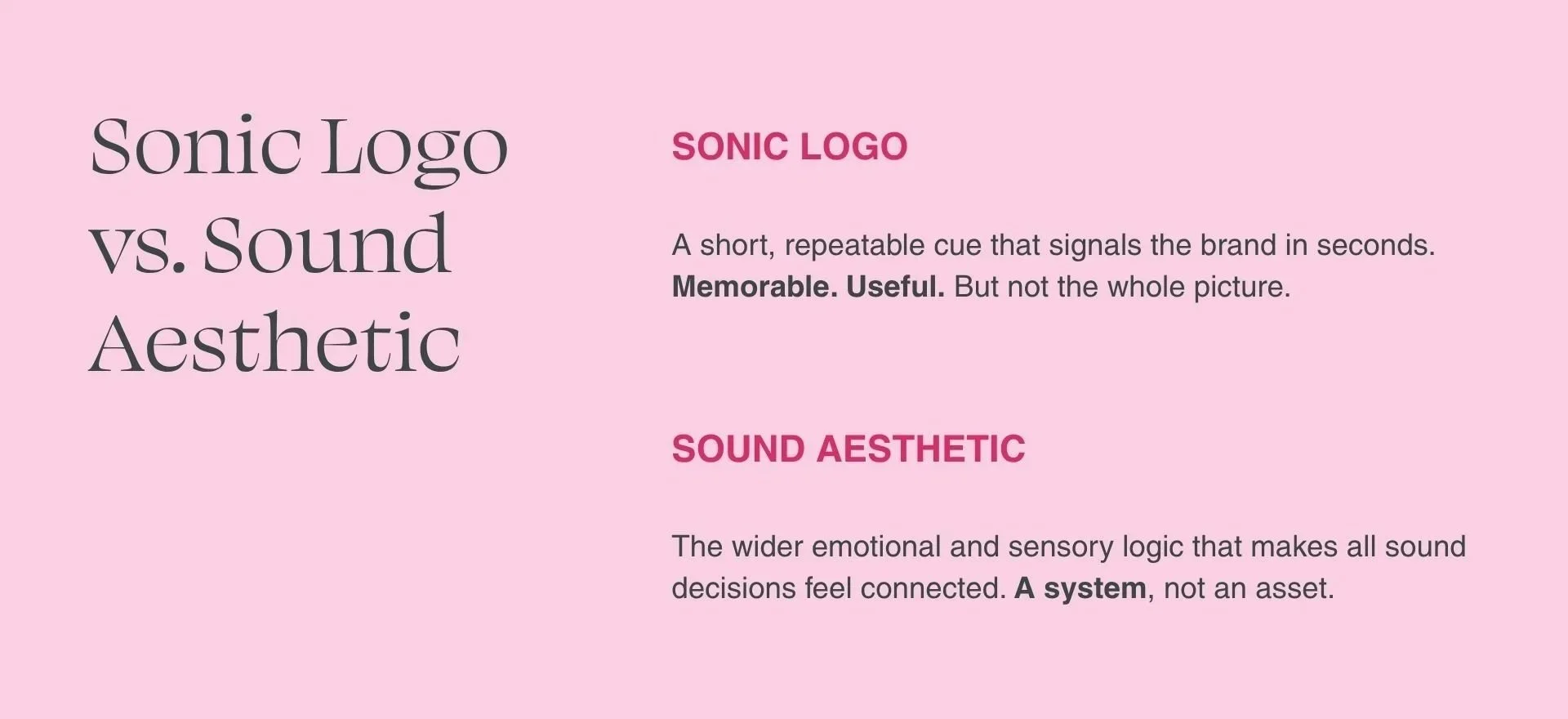
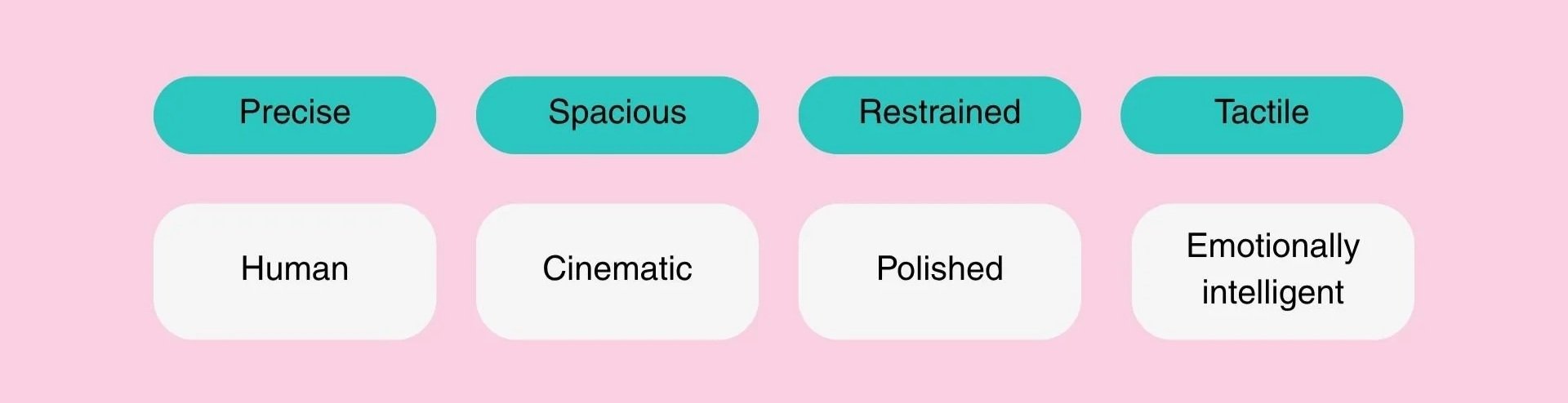
A Sound Aesthetic defines questions like: How much space does the music leave? Does the sound feel polished or raw? Human or futuristic? Tactile or cinematic? Restrained or generous? These are not production questions. They are brand questions. And they need brand-level thinking.
How we work
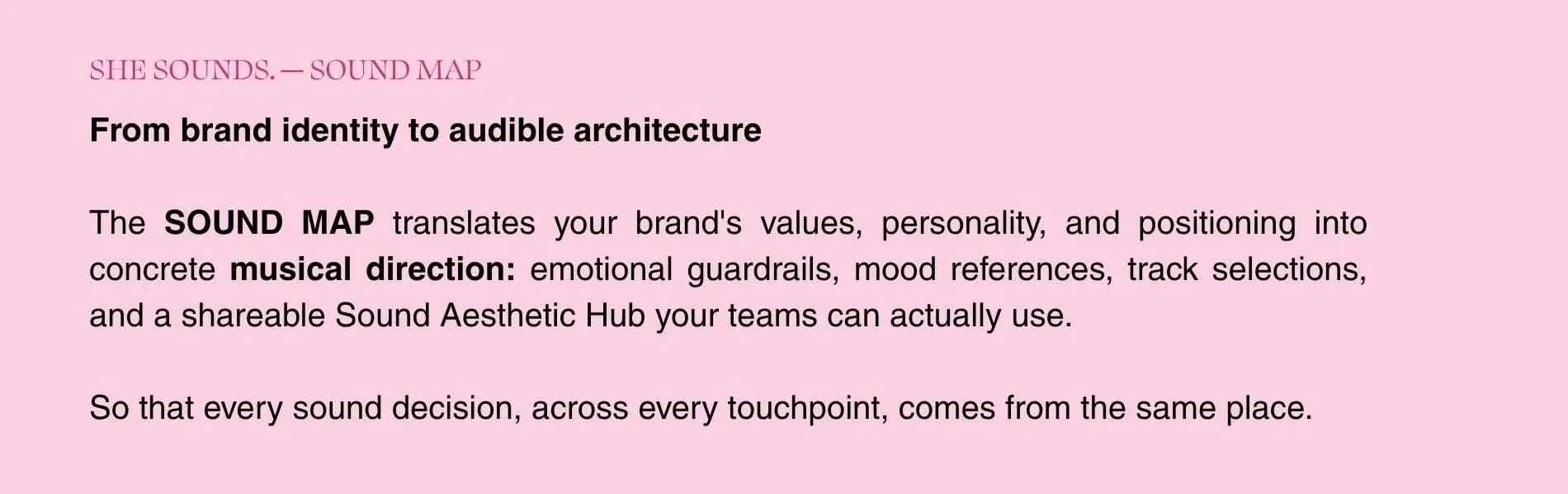
This is precisely what the SOUND MAP, SHE SOUNDS.' core framework, is built to answer. It translates brand identity into a concrete, audible architecture: emotional guardrails, musical direction, mood references, and track selections that give teams something to work from rather than guessing track by track.
What Apple's sound world feels like
Even when Apple uses different composers, different campaign structures, different product narratives, there is a consistency in feeling. The sound rarely feels chaotic. Rarely sonically overcrowded. Rarely like it is trying too hard.
It is not that every piece of music sounds the same. It is that the choices follow the same emotional logic. There is research that explains precisely why this works, and why Apple's approach is so effective.
There is research that helps explain precisely why this works. Studies in cognitive psychology show that auditory memory is processed in brain regions closely linked to emotion, which strengthens recall over time. Separately, research using both Canon and Apple as case studies found that the higher the degree of consistency between the emotional experience of music and brand personality, the greater the positive effect on brand experience and crucially, that this effect is especially significant for aspirational, representative brands rather than purely functional ones. Apple sits squarely in that category.
You can hear this pattern across Apple's campaigns over the past decade. The Underdogs series leaned on upbeat pizzicato strings and busy orchestral momentum. The privacy campaign used piano-led orchestral swell to carry emotional weight with no voiceover. More recent iPhone campaigns have moved further toward score, with film composer Rob Simonsen writing dedicated piano suites directly for the campaign rather than licensing existing tracks. The specific sounds shift. The emotional register does not.
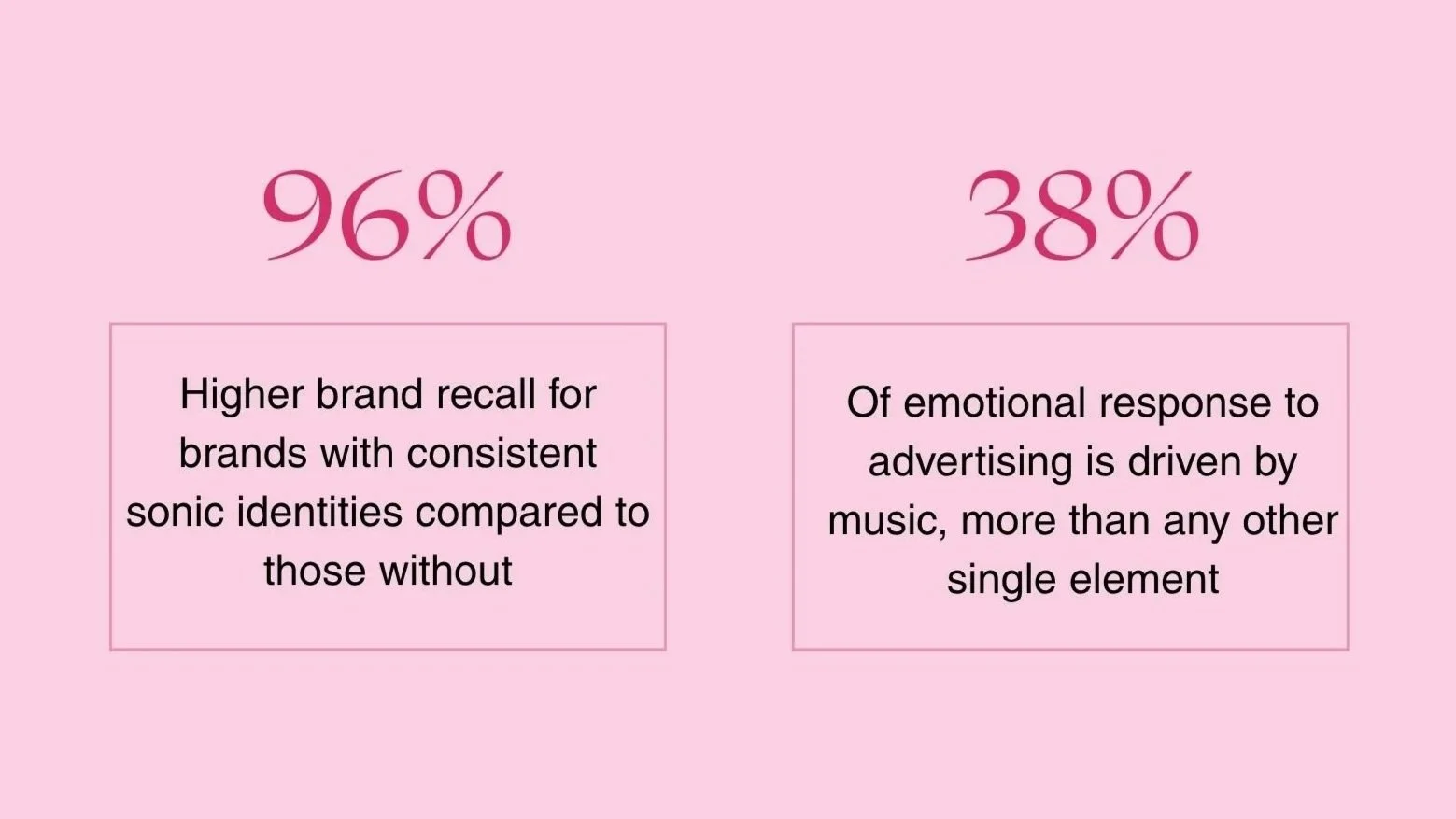
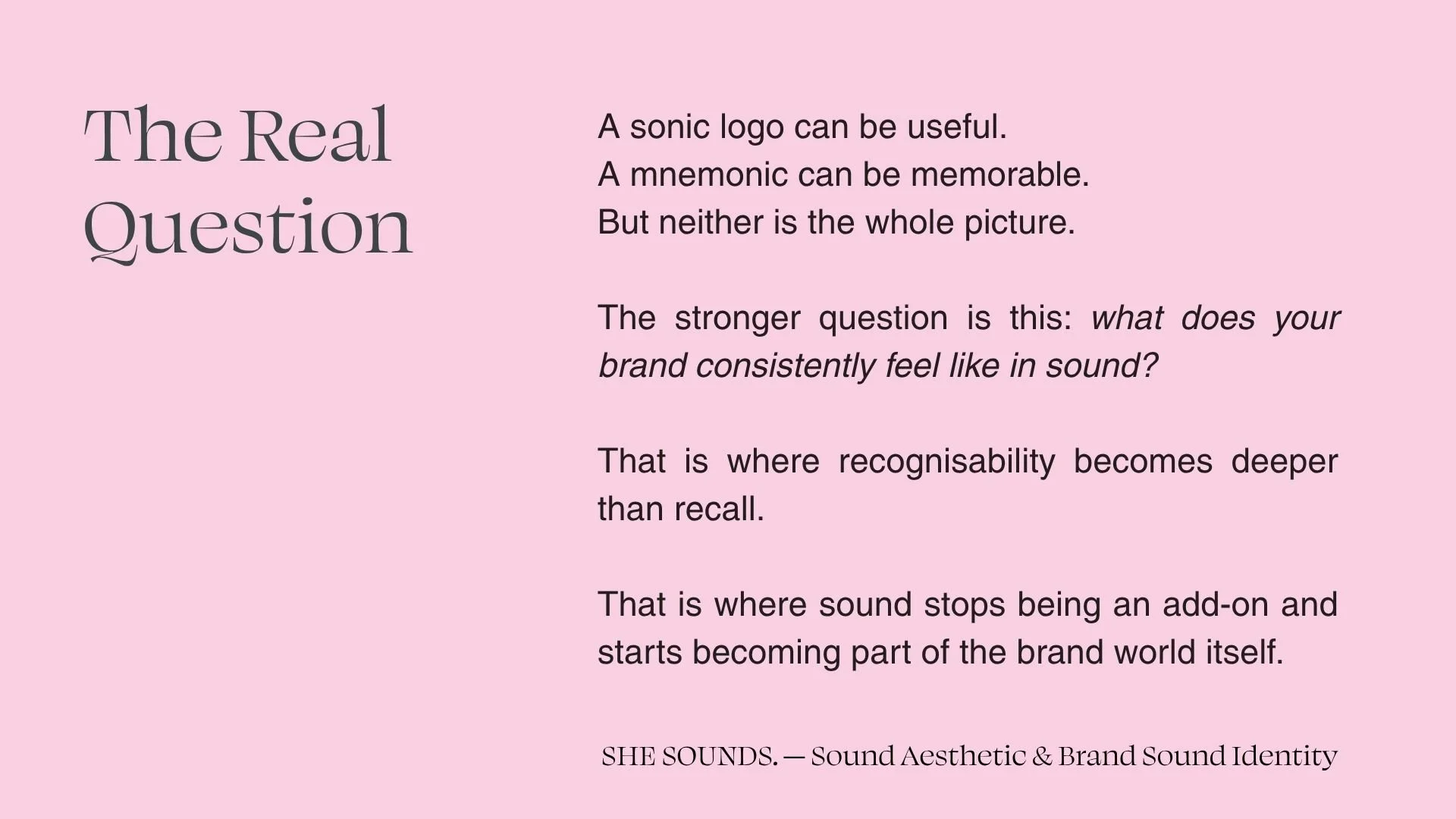
Companies with consistent sonic identities have demonstrated up to 96% higher brand recall than those without. What Apple seems to understand intuitively is that this consistency does not require using the same track twice. It requires producing the same feeling twice. That is a fundamentally different brief. And it is the kind of brief that demands a Sound Aesthetic, not just a music supervisor."
What this means for brand sound is significant: you do not need to play the same track twice to be recognised. You need to make people feel the same thing twice. Coherence in sound is not built by repeating one genre forever. It is built by repeating a consistent emotional standard. That is a fundamentally different brief, and it is the kind of brief that demands a Sound Aesthetic.
Why contemporary classical works so well here
One of the most interesting aspects of Apple's sound is how often it leans toward music that feels closer to score than to traditional advertising music. Minimal piano. Contemporary classical textures. Subtle orchestration. Music with space, tension, and emotional control.
That language creates emotional depth without sentimentality. It feels elevated without becoming ornamental. And it supports exactly what the visual world is already communicating: precision, simplicity, design intelligence, quiet confidence.
This is the kind of thinking that informs how we build Sound Aesthetics at SHE SOUNDS. Not what genre fits this brand, but what emotional standard this brand consistently needs to meet in sound.
Sound design as brand behaviour
Apple's sonic identity is not only built through music. Its product sounds and interface sounds matter just as much, and research consistently supports the idea that interaction sounds function as part of brand identity, not just as utility features.
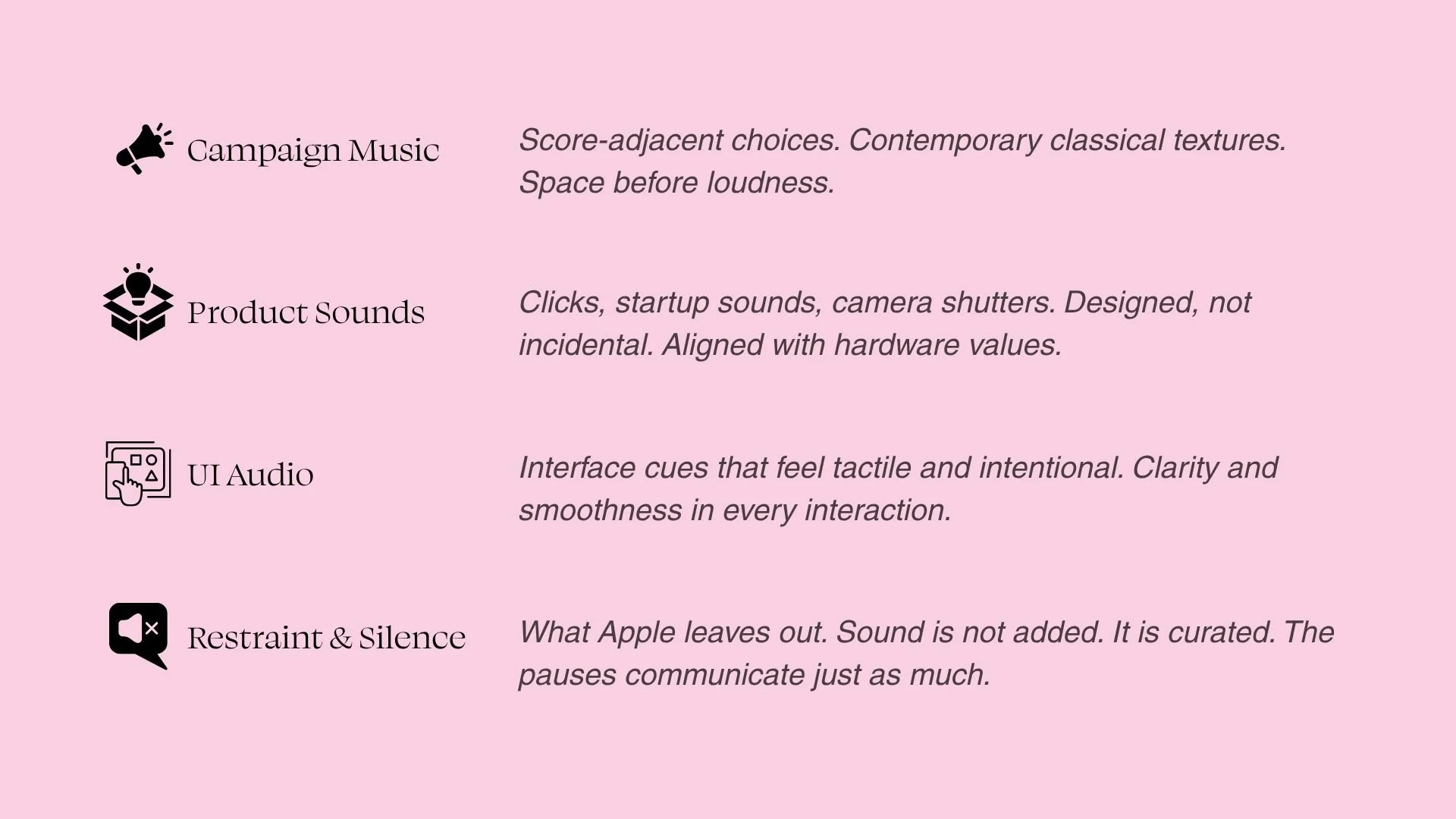
A click is never just a click. A startup sound is never just a startup sound. These sounds shape how a product feels. And in Apple's case, they rarely feel accidental, they feel designed in the same spirit as the hardware itself.
Restraint is part of the identity
The strongest brand sounds are not always the loudest or most obvious ones. Often, what creates distinction is control. In Apple's case, the sound leaves room. It does not overload the edit. It is measured, paced, selective.
That restraint communicates something. It suggests confidence. Authorship. The sense that every choice has been considered. And that is part of why Apple feels premium in sound without needing to announce itself as premium.
The brand does not just add sound. It curates it.
Why most brands still miss this
Many brands still approach sound reactively. Music gets chosen late. Sound design is treated as post-production polish. Different teams make different choices across touchpoints. And the result is inconsistency, one campaign sounds bold and cinematic, the next sounds generic and safe, the product experience has no clear sonic logic, and social content follows platform trends instead of brand identity.
Nothing holds together.
This is exactly what SHE SOUNDS. exists to address. Not by imposing a house style, but by giving brands a clear sound identity they can actually work from: one that is emotionally intelligent, rights-aware, and built around the brand's own values rather than industry defaults.
Apple is useful not because every brand should sound like Apple. It is useful because it shows what happens when sound choices feel aligned to a larger system. The lesson is not to copy the piano, the orchestration, or the product clicks. The lesson is to understand why those choices feel coherent in the first place and then build that coherence for your own brand.
Think about the last piece of content your brand put out. Now strip the visuals away. What is left? Is the sound doing the same work as the image? Is it saying the same thing? For most brands, the honest answer is no. That gap is not a detail. It is a strategic opportunity, and it is still wide open. SHE SOUNDS. exists to help brands close it.
Your brand has a visual identity.
But is it currently mute?
Most brands know exactly how they want to look. They define the colors, the typography, and the world. But when it comes to sound, the process becomes vague. Music is chosen by taste, trends, or convenience. What should feel distinctive ends up sounding like everyone else.
That is the gap we work in.
At SHE SOUNDS., we build Sound Aesthetics. We move away from the "global-generic”, that safe, frictionless audio that is designed to fit every market but ends up moving no one.
We don’t do "one size fits all." We create sonic worlds that align with your brand, emotionally, culturally, and strategically.
The SOUND MAP
Through our proprietary framework, we translate your identity into a functional architecture:
Texture: Is it organic, minimal, or saturated?
Motion: Does it move with restraint or playfulness?
Coherence: Do your ads and your products speak the same language?
This is not about adding music. It is about shaping perception.
Sonic Audit
How does your brand actually resonate? We offer a complimentary 15-minute Sonic Audit to identify:
Where your sound aligns.
Where it creates friction.
Where there is room for a distinctive Sound Aesthetic.
A sharp, outside perspective on the dimension most brands still overlook.
Sources01The impact of consistency between the emotional feature of advertising music and brand personality on brand experience
Hou, J., Zhao, X., Zheng, J. — Journal of Management Analytics, Vol. 6, No. 3, pp. 250–268, 2019. Uses Canon and Apple as case studies. Published by Taylor & Francis.tandfonline.com02Cognitive neuroscience of emotional memory
LaBar, K.S. & Cabeza, R. — Nature Reviews Neuroscience, 2006. On the role of the amygdala and auditory cortex in emotional memory encoding and long-term recall.duke.edu03Emotional Memory — auditory cortex and amygdala in emotional learning
ScienceDirect Topics overview. Covers early research into auditory cortex participation in emotional learning and long-lasting memory trace encoding.sciencedirect.com04The Influences of Emotion on Learning and Memory
Tyng, C.M. et al. — Frontiers in Psychology, Vol. 8, August 2017. On how emotional stimuli processed via auditory and other sensory pathways strengthen memory consolidation over time.frontiersin.org05Sounds like success: How sonic branding can unlock brand potential
WARC / Musicbed. Cites the 96% brand recall figure attributed to the Audio Branding Academy, comparing brands with consistent sonic identities to those using visual branding alone.warc.com06Audio Branding Academy — brand recall research
Research from the Audio Branding Academy cited across multiple industry sources, including Big Invisible and MusicGrid, demonstrating up to 96% higher brand recall for brands with consistent sonic identities versus visual identity alone.biginvisible.com07Creator of Mac startup and iPhone camera sounds talks Apple sound history
Jim Reekes interview with CNBC, covered by AppleInsider, March 2018. Source for the Canon AE-1 camera shutter origin, the Mac startup chord, and Reekes' intention to create soothing, emotionally resetting sounds.appleinsider.com08Story of Sosumi and the Mac Startup Sound
Jim Reekes' own account on his personal website, reekes.net. Primary source for the Canon AE-1 shutter, the C-major startup chord recorded in his living room, and the zen palette cleanser philosophy behind Apple's sound design.reekes.net09Original creator of the Mac startup chime talks its demise and more
9to5Mac coverage of the CNBC Reekes interview, March 2018. Corroborates the Canon AE-1 origin and details Reekes sneaking the new startup chord into the Macintosh Quadra without authorisation.9to5mac.com10The Legendary Canon Camera Behind the Iconic iPhone Camera Sound
PetaPixel, May 2024. Additional detail on the Canon AE-1 shutter origin, including the camera's specific characteristics and how the sound entered the Apple ecosystem through the Mac screenshot function before the iPhone.petapixel.com11I second that emotion: The emotive power of music in advertising
Nielsen, 2015. Analysis of more than 600 television advertisements, over 500 of which included music. Found that ads with music outperformed those without across four key metrics: creativity, empathy, emotive power, and information power. Source for the claim that music is the single most emotive stimulus component in a commercial.nielsen.com12The Effects of Music on Emotional Response, Brand Attitude, and Purchase Intent in an Advertising Context
Morris, J.D. — University of Florida / AdSAM research. Examines music as an emotional stimulus in advertising using the Self-Assessment Manikin to measure emotional response across 12 advertisements. Original methodology source for emotional response measurement referenced in this article. Note: the original PDF at adsam.com is currently unavailable. The study is traceable via Semantic Scholar.semanticscholar.org13I've heard that brand before: the role of music recognition on consumer choice
Anglada-Tort, M. et al. — International Journal of Advertising, 2022. On music familiarity as a driver of brand choice, emotional engagement, and consumer behaviour.tandfonline.com